
Overview
The Date intervals setting determines how time between dates is calculated.
Time between dates can be expressed as a year fraction or as a number of periods and days.
Depending on the selected interest type, additional options are provided.
Date interval settings
Year fraction
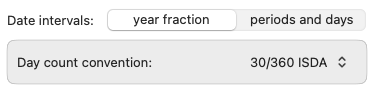
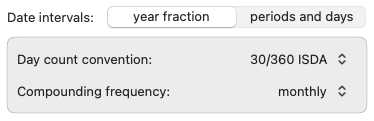
Time between dates is defined as a year fraction, which is calculated using the selected day count convention.
For simple interest, only the day count convention needs to be set.
For compound interest, select the day count convention and the compounding frequency.
Periods and days
Time between dates is calculated as a number of full periods and odd days as defined by the interest periods for simple interest and the compounding frequency for compound interest.
The days fraction for odd days in stub periods is calculated using the selected day count convention.
Other settings appear depending on the interest type settings.
For simple interest, select the interest periods and the days fraction convention.

For simple capitalized interest you can additionally set whether to capitalize on the item date or on a date determined by a reference date.
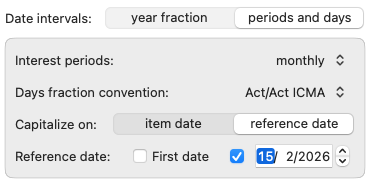
When capitalization is set to occur on the item date, the accrued interest since the date of the previous item is always added on the item date.
This means that when multipe events occur within a period, there will also be multiple capitalizations within a period. The effect is that interest is capitalized more than once inside a period, which is what we call implicit capitalization.
When capitalization is set to occur on a reference date, InterestThing will use the reference date and the interest period to calculate the previous and the next capitalization dates for each data item.
Determining capitalization dates
Example: October 17th, 2024 is set as the reference date,
interest periods are monthly.
For an item dated September, 1st 2026, the previous
capitalization date will be August 17th, 2026 and the next
capitalization date will be September 17th, 2026.
Based on these capitalization dates, it will calculate the number of days before and/or after the respective capitalization dates, and the number of full periods between the previous item and the current item.
This way, capitalization only occurs on capitalization dates as determined by the reference date.
To see which reference dates are calculated, along with the breakdown in periods and days before and after capitalization dates, check the Details tab.
For compound interest, InterestThing will calculate the previous and next compounding dates based on the reference date and the compounding frequency, the same way as is done for capitalized simple interest.
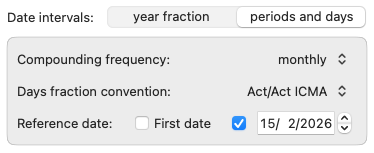
Based on these compounding dates, it will calculate the number of days before and/or after the respective compounding dates, and the number of full periods between the previous item and the current item.
Taking into account any pending interest, compound interest will be calculated and added to the balance.
Simple capitalized interest vs compound interest
The difference between simple capitalized interest and compound interest lies in how interest is calculated.
Example: October 1st, 2025 is set as the reference date,
interest periods are monthly.
Time between dates between October, 21st 2025 and January
21st 2026, is calculated as 11 days until November 1st,
2025, 2 periods from November 1st, 2025 to January 1st,
2026, and 20 pending days from January 1st, 2026 to January
21st 2026.
Supposing that there are also 20 pending days from previous items, on November 1st, 2025 there are 20 + 11 days that need to be capitalized or compounded, along with 2 full periods on January 1st, 2026.
Using capitalized simple interest, simple interest over 20 + 11 = 31 days and 2 months is added to the balance.
Using compound interest, simple interest over 31 days (up to November 1st, 2025) is added to the balance, and to this new balance two months of compound interest is added, resulting in the final balance as of January 1st, 2026.
In both cases 20 days of interest remains pending until the next capitalization or compounding date.
Please note that this is a simplified example, if multiple items fall in the same reference period, pending interest for each sub period is added up using the resulting interest in the sub period, not its number of days.
Related topics
Interest calculation fundamentals
Date interval methods
Day count convention taxonomy
Day count convention reference
Reference days and capitalization