
Most financial software treats calculations as a black box. InterestThing is designed differently — every calculation can be traced back to its source data, verified against published standards, and checked to the cent.
Verification tools
The Tools menu provides two dedicated verification tools for time between date calculations (methods 1 and 2):
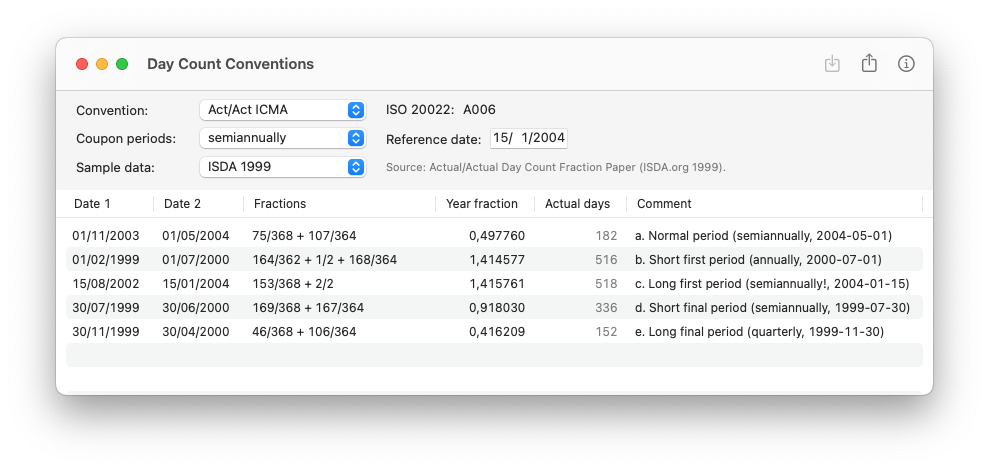
Day Count Conventions — calculates the year fraction using all available day count conventions applied to start and end dates in various test data sets.
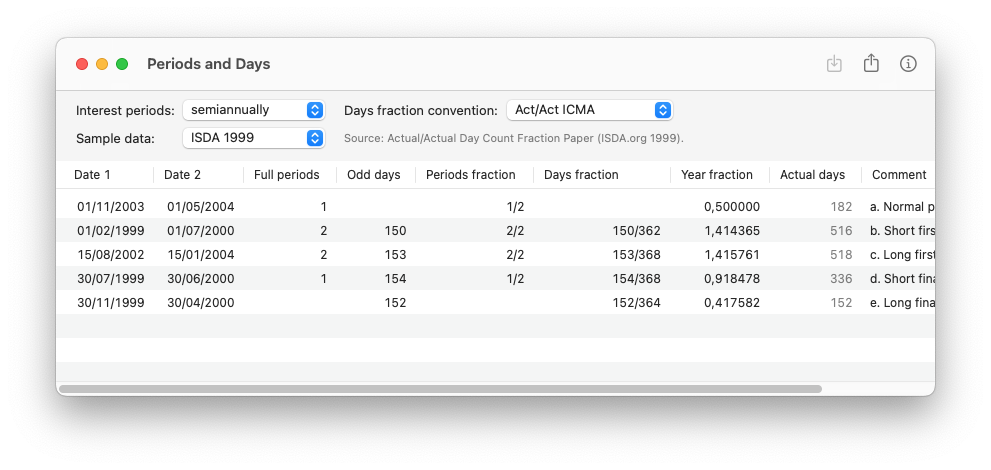
Periods and Days — calculates the periods and days fractions, making it possible to verify how combining different period frequencies and day count conventions influence results.
Test data
InterestThing ships with test data drawn from:
- ISDA 1999 Actual/Actual Day Count Fraction paper
- 2006 ISDA Definitions (30-360-2006ISDADefs.xls)
- ICMA Rule 251 accrued interest calculation
Note: In ISDA 1999, example (c) "Long first calculation period" indicates Annual payments, looking at the calculations it is clear that the payment frequency for the ISMA method should be Semiannual.
Extra sample data are available to test legacy day counts and to demonstrate issues with 30/360 based daycounts. Users can also import their own test data to verify InterestThing's results against existing calculations.
Cash flow window
For cash flows, calculation data are provided in the Cash flow window.
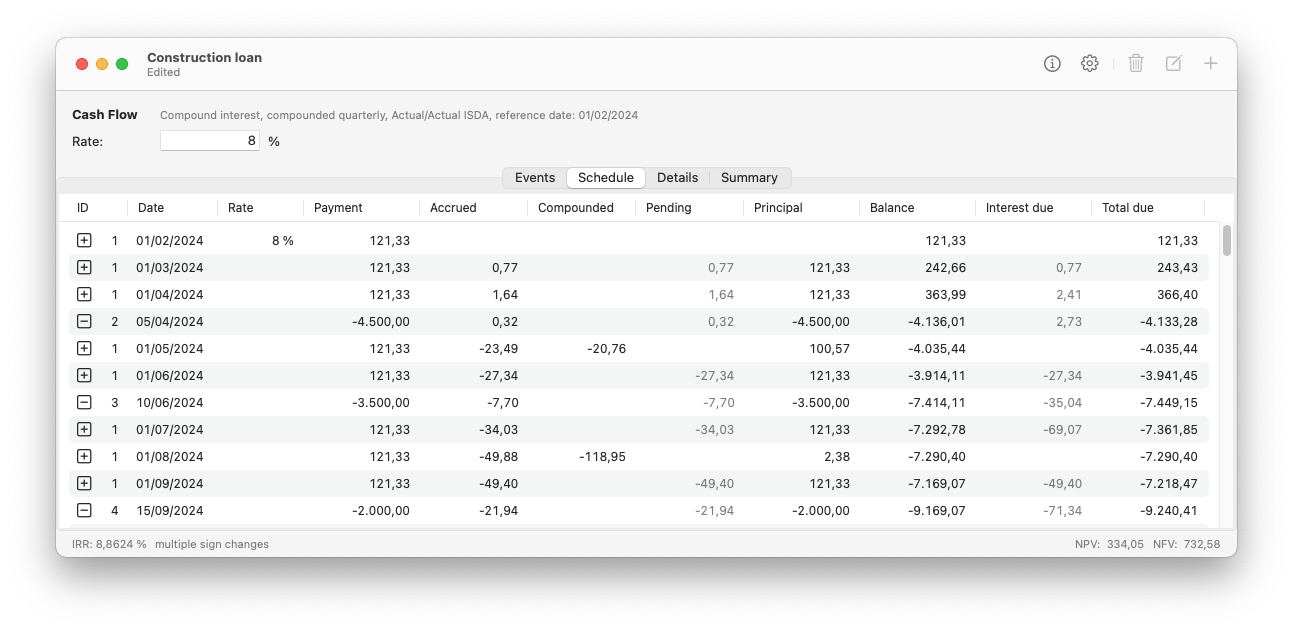
The Schedule tab breaks down every cash flow line into its components:
Insight into accumulated interest across events
The Schedule and Details tabs are valuable for all three date interval methods, but are especially informative for the Periods and days with reference dates method (method 3), where the calculation logic is least obvious.
For this method, interest does not accrue continuously from date to date. Instead, each cash flow item is broken down relative to the previous and next reference dates — generating interest before a reference date, full periods between reference dates, and pending interest after the last reference date.
The Schedule tab shows the financial result of this breakdown: how much interest is accruing, pending, being compounded or capitalized, principal, and balance and interest due after each step.
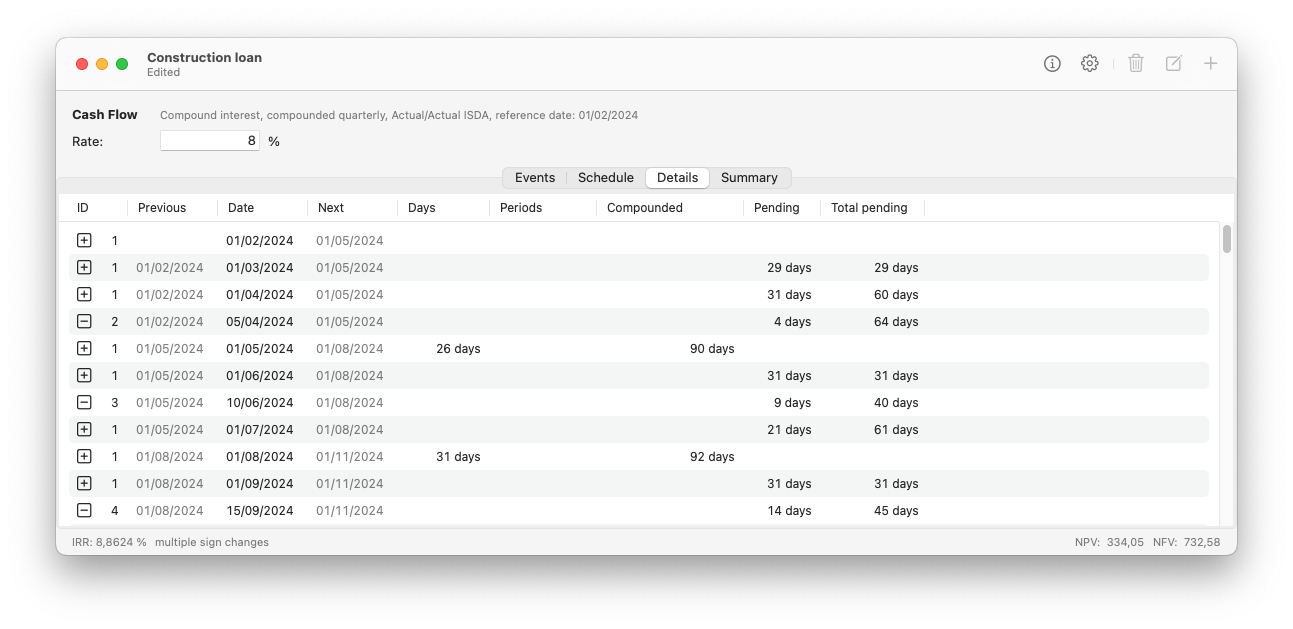
The Details tab shows the underlying date arithmetic that produced those amounts: reference dates, day count before the next reference date, full periods, number of compounded days and periods, day count after the previous reference date and total number of pending days.
For the simpler year fraction method (method 1) and the periods and days without reference dates method (method 2), the Schedule and Details tabs remain useful for tracing how a series of events — investments, returns, rate changes — interact over time, and how interest accumulates between each pair of consecutive dates.